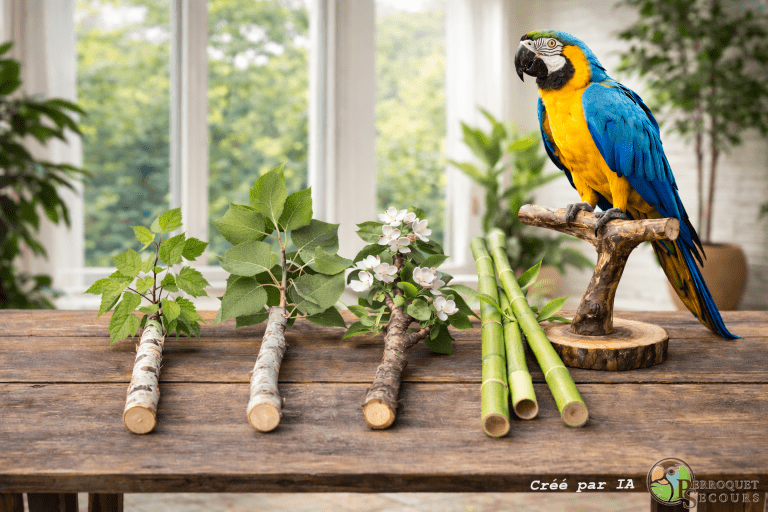
Les bois non-toxiques que vous pouvez utiliser sont :
|
Aubépine |
Hibiscus | Peuplier | Tilleul |
| Agrume (citronnier, oranger, kumquat, etc.) | Java | Pin | Tremble (famille des peupliers) |
| Amandier | Lilas | Platane | Vigne (fruits comestibles) |
| Bambou | Mélèze | Pommetier | Yucca (non traités avec des pesticides). |
| Bignone | Magnolia | Pommier | |
| Bambou | Mangrove | Poirier | |
| Bouleau | Noisetier (sous toutes ses formes) | Roseau | |
| Cholla | Noyer | Rosier (toutes les variétés) | |
| Cornouiller | Mangrove | Poirier | |
| Érable (très bien séché, jamais frais) | Noisetier (sous toutes ses formes) | Roseau | |
| Eucalyptus | Noyer | Rosier (toutes les variétés) | |
| Figuier | Olivier commun (Olea Europaea) | Sapin (sec) | |
| Frêne | Olivier de Bohême (Elægnus angustifolia) | Saule | |
| Hêtre | Orme | Sorbier des oiseleurs (sorbus aucuparia) |
Les bois toxiques qu’il ne faut absolument pas utiliser :
| Abricotier | Chêne (asthme, éternuements, vomissements) | Houx | Philodendron |
| Acacia | Chèvrefeuille | If | Prunier |
| Arbre à perruque | Cyprès | Laurier de montagne | Rhododendron |
| Aulne (irritations et troubles respiratoires) | Érable rouge | Laurier rose | Seringat |
| Avocatier | Ficus | Marronnier commun | Sureau du Mexique |
| Buis | Figuier Pleureur | Mimosa | Sureau noir |
| Caroubier | Fusain | Mûrier chinois | Troène |
| Cèdre | Genévrier | Nectarinier | Vigne vierge. |
| Cerisier | Grenadier (bois et écorce) | Pêchier | |
| Châtaignier | Hortensia |
Wood safe or toxic for birds
Non-toxic woods that can be use are:
|
Hawthorn |
Hibiscus |
Poplar |
Linden |
| Citrus (lemon, orange, kumquat, etc.) | Java | Pine | Aspen |
| Almond tree | Lilac | Plane tree | Vine (edible fruits) |
| Bamboo |
Larch |
Crabapple
|
Yucca (not treated with pesticides) |
| Bignone | Magnolia | Apple tree | |
| Mangrove |
pear tree |
||
|
Birch |
Hazel (in all its forms) |
Reed | |
| Cholla cactus |
Walnut |
Rose bush (all varieties) | |
| Cornouiller | Mangrove | Poirier | |
|
Maple (very well dried, never fresh) |
Common olive tree (Olea Europaea) |
Fir (dry) |
|
| Eucalyptus | Bohemian olive tree (Elægnus angustifolia) | Willow | |
| Fig tree |
Elm |
Rowan (Sorbus aucuparia) |
|
| Ash tree | |||
| Beech |
Toxic woods that absolutely should not be used:
Apricot tree
|
Oak (asthma, sneezing, vomiting) |
Holly |
Philodendron |
| Acacia |
Honeysuckle |
yew tree
|
Plum tree |
|
wig tree |
Cypress
|
mountain laurel |
Rhododendron |
| Alder (irritation and respiratory problems) |
Red maple tree |
Oleander |
Syringat |
|
Avocado tree |
Ficus |
Common horse chestnut |
Mexican elderberry |
Boxwood
|
Weeping Fig Tree |
Mimosa |
Black elderberry |
Carob tree
|
Charcoal tree |
Chinese mulberry |
Privet |
|
Cedar |
Juniper |
Nectarine tree |
Virginia creeper |
| Cherry tree |
Pomegranate tree (wood and bark) |
Peach tree |
|
Chestnut tree
|
Hortensia |
Image credit policy
The images published on this site come from various sources: photographers, partner organizations, image banks, readers, or illustrations generated by artificial intelligence. Where required, images are used with the permission of the rights holder or in accordance with applicable licenses.
Each image is accompanied by a credit indicating, where available, the name of the photographer, organization, or source. Illustrations generated by artificial intelligence are identified as such to ensure transparency for readers.
If you are the copyright holder of an image published on this site and would like additional information, to correct a credit, or to request its removal, please contact our team. We will process all requests as quickly as possible.